Study Strategies!

home-study-course

We are getting to the time of year when exams are on a lot of students’ minds. Biology is looking forward to the Required Quarterly Exam (end of October) and AP Environmental Science is gearing up for its first major exam (Tuesday!!).

Our favorite source high school worthy news, Buzzfeed, has published a GREAT list of study strategies to help you through all of your upcoming exams.

However, a major theme in all of these study strategies is the use of spaced practiced (a.k.a. the opposite of cramming). This means that you need to start your studying well ahead of time so your brain has time to turn that weak understanding into lasting knowledge

For another look at study strategies, check out this piece by The Learning Scientists. This educational psychology blog has put together a resource for students about the most heavily supported style of studying: retrieval practice.

Some last words of wisdom:

  1. Effective studying is hard! But don’t give up – the hard work feeling actually indicates that you’re learning. Easy studying (like re-reading) is just not very effective.
  2. Don’t be afraid to take breaks! Spacing out your practice (over hours or days) is crucial to let your brain move the new information into long term storage.
  3. Test yourself in as many ways as you can! Make up questions, use flashcards, try to write out your notes from memory. There are infinite ways to test yourself.
  4. Teach someone else! This requires a DEEP understanding of the material. If you can convince a friend or family member to sit and listen to you teach them about specialized cells/speciation/genetics/ecology you will be doing yourself a big service.

sim006816

What is assimilation? For a tree: Fungus

david-read-photo-for-mycorrhizae-and-tiny-pine-tree-roots
The fluffy, white fungal network extends way beyond the end of the plant roots. This network is critical to the survival of the plant.

Assimilation is an important part of the nitrogen, phosphorus, and sulfur chemical cycles. Assimilation, sometimes called “uptake,” is the process that plants use to move nutrients that are in the soil into their roots and cell structures.

But how does assimilation actually happen? Are tree roots just like little straws, sucking the phosphates, nitrates, and sulfates out of the soil? It turns out that tree roots are actually really bad at that. Only the very tips of the roots are able to move those nutrient compounds into the plant, and that supplies far less material than the plant needs.

So how do plants take up the nitrogen, phosphorus, and sulfur that they need? In a word: fungus.

There is a network of fungus tubules stretching through forest ground. These fungus tubes invade tree roots, but not to harm: to give. The fungus tubes funnel harvested mineral nutrients (nitrates, phosphates, and sulfates) to the tree, while the tree sends off huge amounts of photosynthesized sugar to the heterotrophic fungi.

The mutualistic partnership is incredible in scope. By some estimates, the trees siphon off up to 80% of their photosynthesized sugar to the fungal network below them. And on the other hand, the fungus is actively mining and hunting phosphates and nitrates to provide to the plant.

The network is massive and surprisingly active. Listen to the RadioLab episode about the fungus-tree partnership (below).

https://www.wnyc.org/widgets/ondemand_player/radiolab/#file=%2Faudio%2Fxspf%2F648425%2F

Homework: Week of 9/19/16

Biology Homework

Monday 9/19

  • Enjoy a night off!
  • But also do your memrise words everyday! 🙂

Tuesday 9/20

Wednesday 9/21

Thursday 9/22

Friday 9/23

  • Due Monday 9/26 – Finish page 26 in your ISN.
  • Due Monday 9/26 – Choose a partner for your Sports Injury Project. Fill out this Partner Selection form. Choose your partner carefully! Obviously, they need to be in the same period as you. But beyond that, choose someone who you feel you work well with.
  • Do your memrise words everyday!

APES Homework

Monday 9/19

  • Due Tuesday 9/20 by 7:00am – Watch video #5. The link is on Google Classroom.
  • Continue reading Chapter 3 and taking notes accordingly. Your quiz is on Friday 9/23.
  • Begin working on Chapter 3 objectives. They are due Thursday 9/22.

Tuesday 9/20

  • Ms. Lassar out sick

Wednesday 9/21

  • Due Thursday 9/22 by 7:00am – Watch video #6 and fill out the form with questions about the video. The link is on Google Classroom.
  • Due Friday 9/23 by 7:00am on turnitin.com Chapter 3 objectives.
  • Due Monday 9/26 by 7:00am on turnitin.com – NPP GPP lab write up. This is your first formal lab report. It is only a brief lab report, but make sure that you address every component on the rubric/description document. Here is the class data.
  • Continue reading Chapter 3 and taking notes accordingly. Your quiz is on Monday 9/26.

Thursday 9/22

  • Due Friday 9/23 by 7:00am on turnitin.com -Chapter 3 objectives.
  • Due Monday 9/26 by 7:00am on turnitin.comNPP GPP lab write up. This is your first formal lab report. It is only a brief lab report, but make sure that you address every component on the rubric/description document. Here is the class data.
  • Quiz on Chapter 3 – Monday 9/26

Friday 9/23

  • Due Monday 9/26 by 7:00am on turnitin.comNPP GPP lab write up. This is your first formal lab report. It is only a brief lab report, but make sure that you address every component on the rubric/description document. Here is the class data.
  • Quiz on Chapter 3 – Monday 9/26

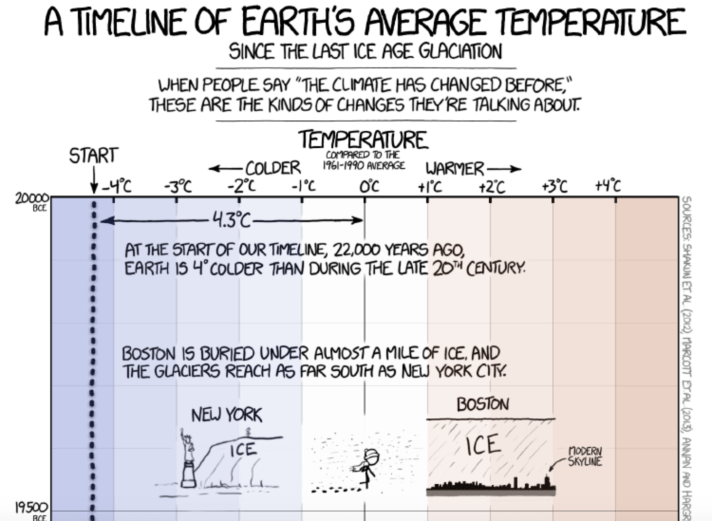
How fast does the Earth change temperature?

How fast does the average temperature change on Earth?

Check out this amazing comic strip.

screen-shot-2016-09-12-at-7-11-16-pm

It’s pretty mind-blowing stuff.

Food for thought:

  1. How could you mathematically describe the change in the rate of change of temperature (eek – tough wording!)?
  2. How do scientists measure average world temperature anyway?

Munroe, Randall. “Earth Temperature Timeline.” Xkcd. http://xkcd.com/1732/.

Antibiotic Resistance on a GIANT Petri Dish

What’s the best way to understand the reality of antibiotic resistance developing in bacteria? Set it up in a mega-sized petri dish.

A team of scientists at Harvard University have set up an elegant way to visualize the antibiotic resistance that bacteria develop as they are exposed to antibiotics over time.

The team created a giant (really: it was 2′ x 4′!) petri dish with bands of increasing levels of antibiotic. The lowest levels of antibiotic were along the edges of the plate, while the center had 1,000 times the amount of antibiotic that the bacteria can typically survive.

Over the span of just 10 days, the initially drug-susceptible bacteria conquered each successive level of antibiotic concentration. You can watch their beautifully dangerous progression across the plate in the video above.

Food for thought:

  1. What are the risks of conducting an experiment like this?
  2. What can we learn by studying the path and timing that the bacteria take across the increasing levels of antibiotic?
  3. What do you want to know after watching this video?

Read more about the experiment, set-up, and results in the original article.

Pesheva, Ekaterina. “A Cinematic Approach to Drug Resistance.” Harvard Gazette. Harvard University, 8 Sept. 2016. http://news.harvard.edu/gazette/story/2016/09/a-cinematic-approach-to-drug-resistance.

Homework: Week of 9/6/16

Biology Homework

Tuesday 9/6

  • Due Friday 9/9: Add yourself to the Biology A Google Classroom page:
    • Period 2: gbxpve
    • Period 4: 8q68km
    • Period 5: 7ffspl
    • Period 6: idfnxss
    • For detailed instructions, see this page written by Google.
  • Due Thursday 9/8: Finish the Properties of Water lab write up. Here are the Station Markers if you would like to refresh your memory.
  • Upcoming: Your Properties of Water quiz will be on Friday 9/9!
  • Do your memrise words everyday!

Wednesday 9/7

  • Due Friday 9/9: Add yourself to the Biology A Google Classroom page:
    • Period 2: gbxpve
    • Period 4: 8q68km
    • Period 5: 7ffspl
    • Period 6: idfnxss
    • For detailed instructions, see this page written by Google.
  • Due Thursday 9/8: Finish the Properties of Water lab write up.
  • Due Thursday 9/8: Finish the Properties of Water lab write up. Here are the Station Markers if you would like to refresh your memory.
  • Upcoming: Your Properties of Water quiz will be on Friday 9/9!
  • Do your memrise words everyday!

Thursday 9/8

  • Due Friday 9/9: Finish pgs. 10 and 11 in your ISN. This is the Effects of Water on the body reading. If you need another copy of the article, here it is!
  • Due Friday 9/9: Add yourself to the Biology A Google Classroom page:
    • Period 2: gbxpve
    • Period 4: 8q68km
    • Period 5: 7ffspl
    • Period 6: idfnxss
    • For detailed instructions, see this page written by Google.
  • Your Properties of Water quiz will be on Friday 9/9!
  • Do your memrise words everyday!

Friday 9/9

  • Have a great weekend!
  • Do your memrise words everyday!

APES Homework

Tuesday 9/6

  • Due Wednesday 9/7 by 7:00am: Complete questions 16-19 in the Ecological Footprint Webquest on Google Classroom.
  • Due Wednesday 9/7 by 7:00am: Complete Video #2 (the link is accessible on Google Classroom). It is a video quiz hosted on EdPuzzle.com. If EdPuzzle asks you to accept permissions, grant them access.
  • Continue out-of-class work on the Life Cycle Analysis Research Project. Your final project must be “Turned In” on Google Classroom by 7:00am on Friday 9/9.
  • Quiz on Chapters 1 and 2 is on Tuesday 9/13. You should be reading both chapters and taking notes accordingly.

Wednesday 9/7

Thursday 9/8

  • Due Friday 9/9 by 7:00am: Complete Video #3 and response on Google Classroom.
  • Continue out-of-class work on the Life Cycle Analysis Research Project. Your final project must be “Turned In” on Google Classroom by 7:00am on Friday 9/9.
  • Due Monday 9/12 by 11:59pm: Tragedy of the Commons Response. Your response must be uploaded to turnitin.com
  • Due Monday 9/12 by 11:59pm: Chapter 1 and 2 objectives. Your response must be uploaded to turnitin.com
  • Quiz on Chapters 1 and 2 is on Tuesday 9/13. You should be reading both chapters and taking notes accordingly.

Friday 9/9

  • Due Monday 9/12 by 11:59pm: Tragedy of the Commons Response. Your response must be uploaded to turnitin.com
  • Due Monday 9/12 by 11:59pm: Chapter 1 and 2 objectives. Your response must be uploaded to turnitin.com
  • Quiz on Chapters 1 and 2 is on Tuesday 9/13. You should be reading both chapters and taking notes accordingly.

Wildcam Gorongosa

Want to be part of conservation wildlife biologists’ efforts to monitor the recovery of animal populations at Gorongosa National Park?

Teams of conservation biologists have set up a network of over 50 motion activated cameras all over the park. These cameras take dozens of pictures a day, and have been active for a few years. Here’s where you step in.

Instead of spending thousands of hours categorizing the animals found in each photo, the biologists are outsourcing it to citizens all over the world. Anyone (including you!) can logon to https://www.wildcamgorongosa.org/ and start categorizing the animals you see in each photo.

The website will teach you how to identify species from the massive list of native animals. If you find a particularly awesome (or confusing) photo, you can even open up a chat with other volunteers.

I’m keeping track of the animals I’ve seen. My goal is to identify one of each animal on the species list! So far I’ve seen:

  • Bushbuck
  • Oribi
  • Baboon
  • Warthog
  • Eland
  • Civet
  • Unidentified reptile
  • Humans! (They set off the camera when they check the area)
  • Impala
  • Nyala
  • Totally empty pictures with no animals at all (Sometimes moving grass sets off the cameras too)

Have fun identifying animals!


Biodiversity Improves Drought Resilience of Salt Marshes

sapelo20oakdale20creak20die20off20july202016
Sapelo Island, Georgia salt marsh during a 2016 drought. Credit: Christine Angelini

A team of researchers from the University of Florida have just identified a key example of protective biodiversity. They noticed that during a drought, while most salt marsh grasses quickly die off some small patches of grass remain.

When they examined the surviving patches of grass, they found that the patches were heavily surrounded (“paved”) with ribbed mussels. The community of mussels is able to trap water effectively around the base of the salt marsh grasses, protecting it from the effects of drought.

In fact, when the drought is over, the patches of surviving salt marsh grass are able to quickly repopulate the area. The salt marsh is able to return to their health it had prior to the drought.


Food for thought:

What are the mussels getting out of this relationship?

Does this mean we should transplant mussels into other drought affected salt marshes?


Leave your thoughts in the comments!


Article adapted from: “Biodiversity in Salt Marshes Builds Climate Resilience.” NSF News. National Science Foundation. http://www.nsf.gov/discoveries/disc_summ.jsp?cntn_id=189416&WT.mc_id=USNSF_51&WT.mc_ev=click.

Lab Safety 101


Well… let’s kick it off with what NOT to do.


Challenge: How MANY issues could you spot in that video?

Nice job: 10 issues

You’re getting the hang of it: 18 issues

You’re ready for the lab: 22+ issues


Lab safety is a big deal. In fact, you’ll need to prove your safety smarts every year from now until you finish your science career.

MCPS uses Flinn Scientific’s Lab Safety Contract and Quiz. You will be held to the guidelines on this contract. Now is a great time to review the contract and the quiz that you will take every year in high school.

Test Yourself! 

Try out the lab safety quiz questions on LassarScience.com!

Homework: Week of 8/29/16

Biology Homework

Monday 8/29

  • Figure out how you will get your Interactive Science Notebook, so you have it in class on THURSDAY 9/1. This is critical. Your notebook MUST meet ALL of the following requirements:
    • Spiral bound
    • At least 70 pages
    • 8.5″ x 11″ pages
    • College ruled
  • See Ms. Lassar ASAP if procuring this notebook is a problem – I will provide you with one.
  • Due Thursday 9/1: Read the Biology A Syllabus and Digitally Sign it. You will need to provide your email address and your parents’/guardians’ email addresses too.
  • Practice for the Lab Safety Quiz by solving the lab safety questions on LassarScience.com

Tuesday 8/30

  • Figure out how you will get your Interactive Science Notebook, so you have it in class on THURSDAY 9/1. This is critical. Your notebook MUST meet ALL of the following requirements:
    • Spiral bound
    • At least 70 pages
    • 8.5″ x 11″ pages
    • College ruled
  • See Ms. Lassar ASAP if procuring this notebook is a problem – I will provide you with one.
  • Due Thursday 9/1: Read the Biology A Syllabus and Digitally Sign it. You will need to provide your email address and your parents’/guardians’ email addresses too.
  • Due Friday 9/2: Add yourself to the Biology A Google Classroom page:
    • Period 2: gbxpve
    • Period 4: 8q68km
    • Period 5: 7ffspl
    • Period 6: idfnxss
    • For detailed instructions, see this page written by Google.

Wednesday 8/31

  • Figure out how you will get your Interactive Science Notebook, so you have it in class on THURSDAY 9/1. This is critical. Your notebook MUST meet ALL of the following requirements:
    • Spiral bound
    • At least 70 pages
    • 8.5″ x 11″ pages
    • College ruled
  • See Ms. Lassar ASAP if procuring this notebook is a problem – I will provide you with one.
  • Due Thursday 9/1: Read the Biology A Syllabus and Digitally Sign it. You will need to provide your email address and your parents’/guardians’ email addresses too.
  • Due Thursday 9/1: Finish Soap Boat lab analysis

Thursday 9/1

  • Due Friday 9/2: Finish “left side” analysis of Properties of Water – Introduction
  • Due Friday 9/2: Number ALL pages of your Interactive Science Notebook (ISN).
  • Start reviewing vocabulary on memrise. Want the most impact for your effort? Practice these words everyday! You should start on the Properties of Water level.

Friday 9/2

  • Due Tuesday 9/6: Finish pages 6 and 7 in your ISN. See the ISN pages for what should go on there.
  • Due Tuesday 9/6: Tape the introductory pages into your ISN. Highlight or underline key parts of each page. Write any questions you have on sticky notes. If you forget what order they go in: look at the first few pages of the ISN pages.
  • Due Wednesday 9/7: Finish the Properties of Water lab write up.
  • Upcoming: Your Properties of Water quiz will be on Thursday 9/8!
  • Do your memrise words everyday!


APES Homework

Monday 8/29

Tuesday 8/30

  • Due Wednesday 8/31  – Homework #1 and response. Watch Video #1 “What is Development” and answer the prompt on Google Classroom.
  • Practice for the Lab Safety Quiz by solving the lab safety questions on LassarScience.checkle.org

Wednesday 8/31

Thursday 9/1

Friday 9/2